For decades, organizations have been forced to make a difficult choice when it comes to workforce development. Training could be highly personalized, or it could be highly scalable. Rarely could it be both.
The most effective learning experiences have always been deeply individualized. A great mentor adapts explanations based on a learner's existing knowledge. A skilled coach identifies misunderstandings before they become habits. An experienced instructor knows when to move quickly through familiar concepts and when to slow down and provide additional support. The effectiveness of these approaches comes not from the content itself, but from their ability to adapt to the individual.
Research has consistently supported this idea. In one of the most influential studies in educational psychology, Benjamin Bloom found that students receiving one-to-one tutoring dramatically outperformed students learning through traditional classroom instruction.
For most organizations, personalization has simply been too expensive. As companies grew, learning programs became increasingly standardized. Every employee received the same onboarding experience. Every manager completed the same leadership curriculum. Every compliance learner worked through the same training pathway regardless of prior experience, existing knowledge, or demonstrated competency.
This solved the problem of scale, but it introduced a different problem. Learning became generic.
Most employees have experienced this firsthand. High performers sit through content they already understand. New hires receive information long before it becomes relevant. Experienced professionals spend hours completing mandatory courses that provide little value. At the same time, employees who genuinely need additional support often struggle because the training moves forward before they have mastered foundational concepts.
The result is that organizations spend enormous amounts of time and money delivering learning experiences that are designed for everyone and therefore optimized for no one.
Artificial intelligence is beginning to change this equation.
Much of the conversation surrounding AI in learning has focused on content creation. Organizations can now generate courses, assessments, quizzes, and learning materials in minutes rather than weeks. While impressive, speed is not the most important shift underway. Creating content faster does not automatically create better learning outcomes.
The more significant transformation is that AI makes personalization economically viable at a scale that was previously impossible.
Recent research provides a glimpse of what this future may look like. In a randomized controlled trial published in Nature Scientific Reports in 2025, students learning with an AI tutor learned substantially more than students participating in active-learning classroom instruction. They also completed the material in less time while reporting higher levels of engagement and motivation.
The implications extend far beyond education.
For decades, workforce learning has been constrained by a simple operational reality: every learner is different, but most training systems treat them the same. Learning platforms were designed around courses. Employees were assigned content based on job title, department, or compliance requirements. Personalization was limited because creating unique pathways for thousands of employees required enormous amounts of manual effort.
Today, AI makes a different approach possible.
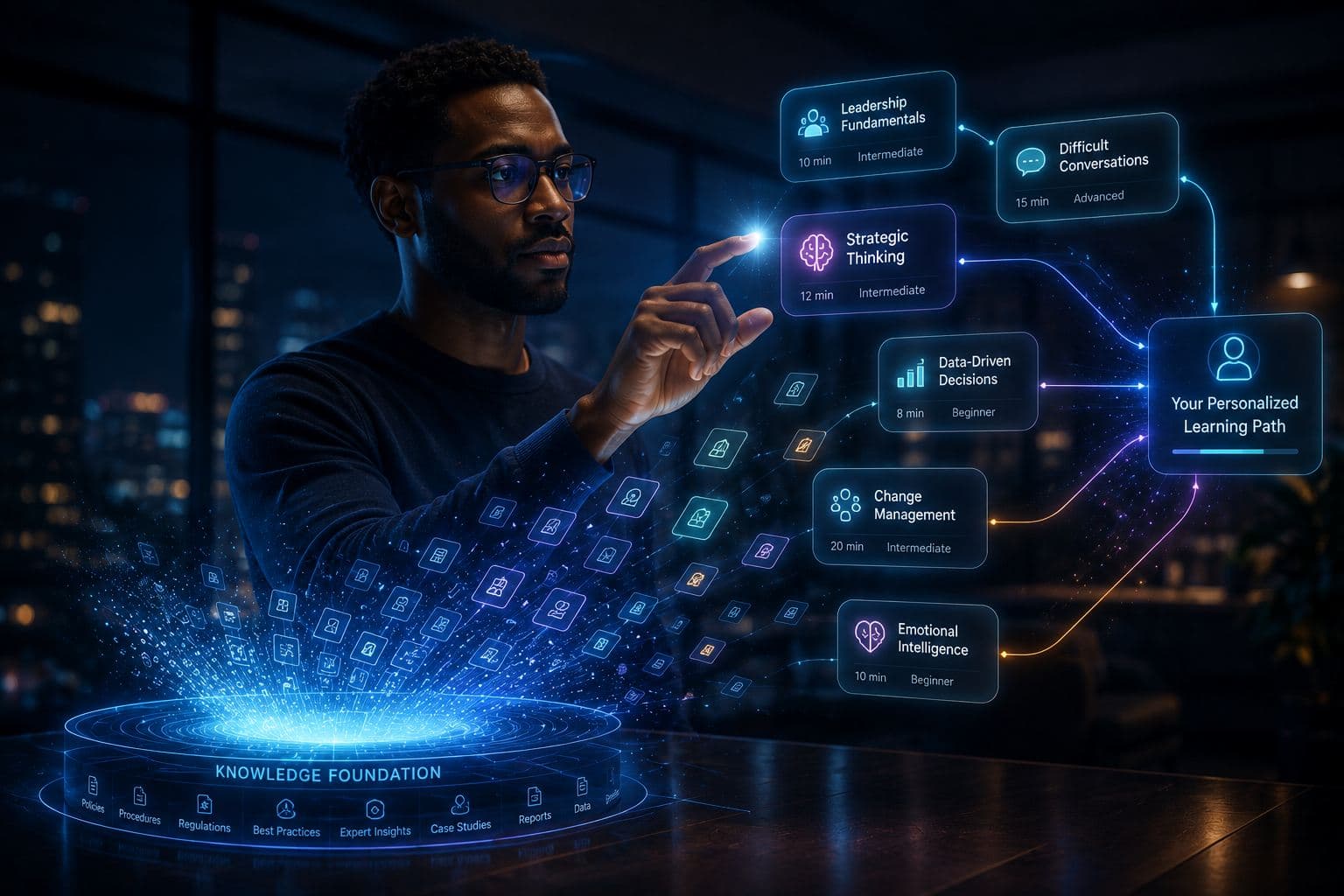
When combined with structured organizational knowledge, competency frameworks, and knowledge graphs, AI systems can generate individualized learning experiences based on the specific needs of each employee. A new hire can receive foundational knowledge tailored to their role. An experienced employee can skip concepts they have already mastered. A manager preparing for promotion can focus on leadership capabilities relevant to their next position. Employees struggling with a particular concept can receive additional examples, practice opportunities, and reinforcement exactly when they need it.
The learning pathway itself becomes adaptive.
At Nexera, we believe this represents a shift from course-centric learning to learner-centric learning. Instead of building a single course and assigning it to thousands of employees, organizations can build a trusted knowledge foundation and generate personalized learning experiences from that foundation automatically.
This matters because workforce learning is increasingly tied to business outcomes. Organizations are facing growing pressure to develop skills faster, retain talent longer, and create clearer pathways for employee growth.
The connection between learning and retention is particularly striking.
These findings suggest that workforce learning is no longer simply about compliance or knowledge transfer. Increasingly, it is becoming a core component of employee engagement, career mobility, and organizational resilience.
For decades, organizations have known that personalized learning produces better outcomes. The obstacle has never been educational theory. It has been economics. Creating individualized learning experiences for thousands of employees required resources that most organizations simply did not have.
Artificial intelligence changes that equation.
The future of workforce learning will not be defined by how many courses an organization can create. Content is rapidly becoming abundant. The organizations that create the greatest value will be those that can ensure every employee receives the right knowledge, at the right time, in the right format, based on their unique goals, responsibilities, and capabilities.